

- This event has passed.
Club Event
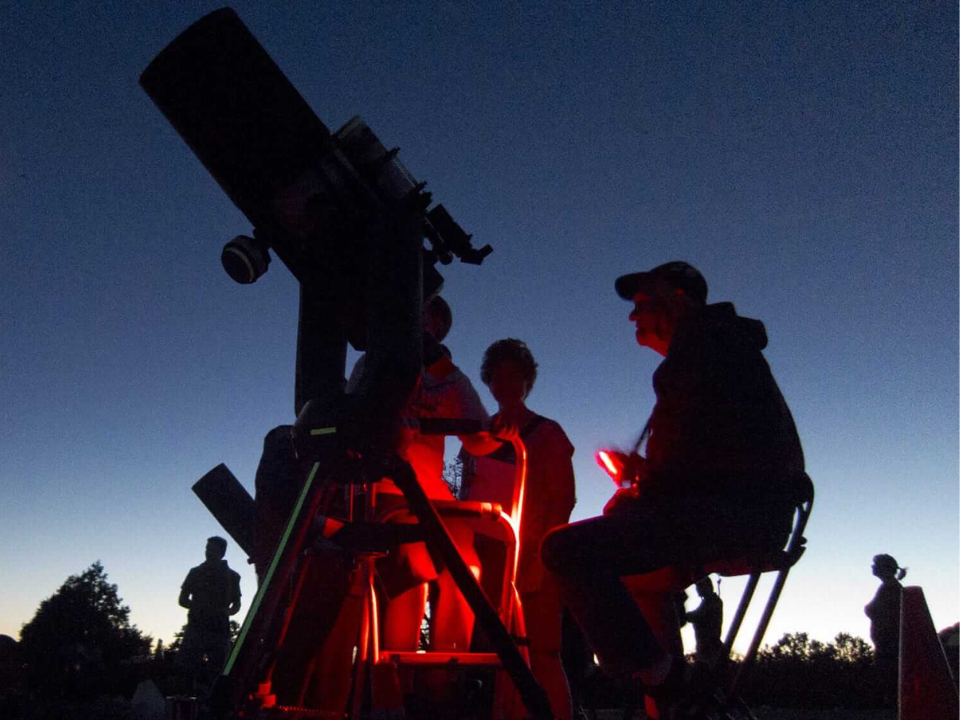
Carolina Skies Astronomy Club’s next observing night will be this Saturday at the North Carolina Museum of Natural Sciences at Contentnea Creek (A Time for Science – Grifton). Tonight, we have one asteroid, two comets, four globular star clusters and five planets in position to observe. Most importantly, we will have a very clear sky and no moonlight.
Mars and Mercury are in conjunction and visible near the horizon about 20 minutes after sunset. Mercury is much brighter than Mars.
Comet Swan is in the Southwest and Lemmon in the West. Bring binoculars and see if you can spot them after twilight ends.
Most globular clusters are best observed in summertime, but, M71, M15, M2, and M30 can be seen in October.
Saturn will transit about 11:00PM, which means it will be great to observe all night.
Neptune is tracking just behind Saturn. At magnitude 7.8 you will need a telescope to spot it.
Uranus will be high enough to observe after 9:00PM. At magnitude 5.6 you might find it with binoculars, but a telescope is necessary to see it is a planet. It is now magnitude 5.6.
If you want a real challenge, look for Ceres (the largest object in the asteroid belt). It is magnitude 7.7.